
Wet Clutch RFQ: Friction Set or Controlled Rebuild Stack?
Define the authorized clutch-stack requirement and retained-component boundary before comparing friction-only sets with broader rebuild kits.
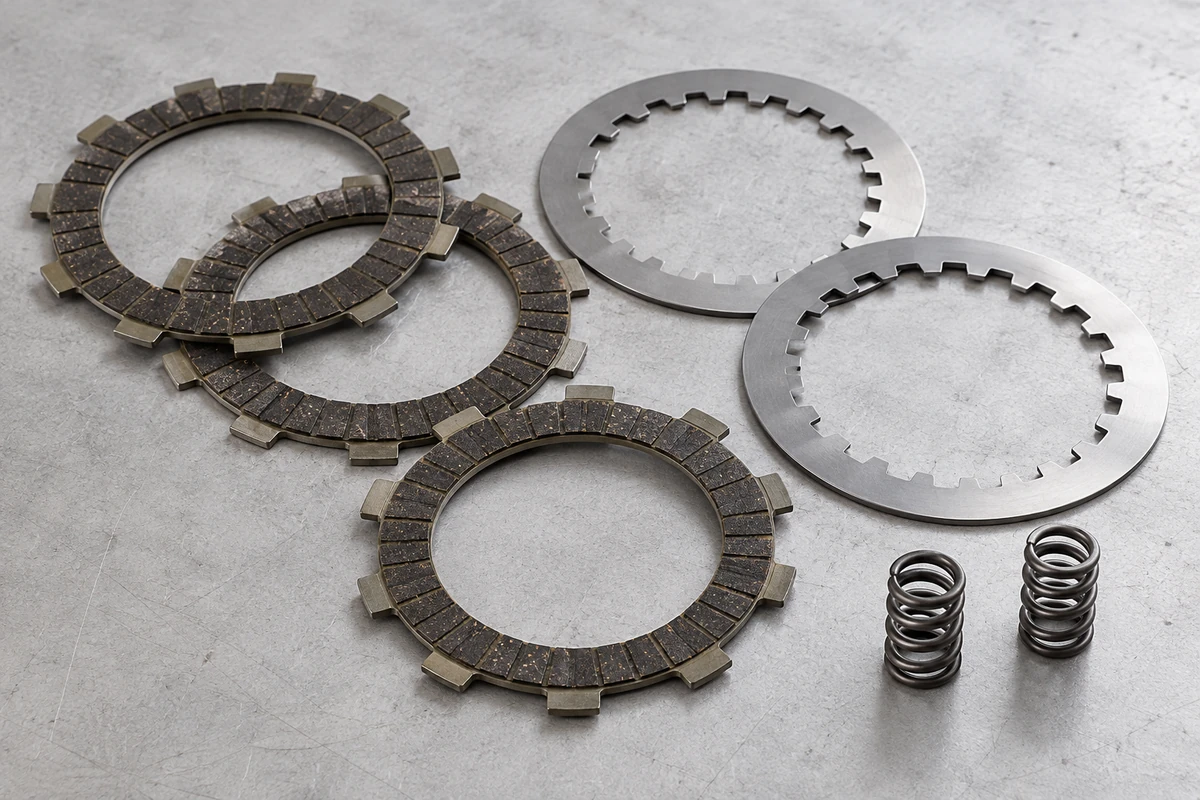
An RFQ for a wet clutch rebuild needs more than a plate count. State whether the authorized job calls for a friction set or a broader group including specified steel plates and springs. Preserve the source of the complete stack requirement so that a cheaper quotation cannot silently change the rebuild boundary.
The buyer is not diagnosing the clutch or choosing parts to correct a symptom. That work belongs to the responsible technical provider. Purchasing should carry the approved requirement into the supplier enquiry and make any retained-component assumption explicit.
Read friction-set and rebuild descriptions separately
EBC describes its CK series as a stack-height-controlled friction-plate set. Its DRC page describes a broader kit containing friction plates, steel intermediate plates and springs. Those named range descriptions demonstrate different supply scopes; they do not establish the required stack or spring specification for an unknown motorcycle. EBC CK series · EBC DRC kits
Do not turn 'clutch kit' into a universal bill of materials. Ask for the exact offered application and product reference, then the component groups it includes. A photograph showing several plates may help identify the listing, but it does not answer the required set specification or the steel and spring scope.
The purchasing distinction is not whether one box is larger. It is whether the proposed set preserves the authorized relationship between supplied parts and any retained parts. A more comprehensive kit still needs exact application confirmation.
Tie stack coherence to an authoritative requirement
Record the model-specific stack specification source, its revision and the provider who approved the rebuild scope. Keep the supplier's set description separate from that requirement. A supplier claim about stack control is useful evidence to examine, not permission to infer the applicable target from an unrelated product range.
Where the job retains steel plates or springs, the retention basis must come from the technical provider. A seller's omission of those items does not establish their suitability. Where the job requires them, an offer containing only friction plates has changed the scope even if its plate count sounds complete.
For a custom or unbranded proposal, request the released set specification and the supplier's explicit deviations. Do not assume independently sourced pieces form an acceptable stack because their nominal descriptions look similar. The RFQ is not an invitation to select individual thicknesses or spring rates by price.
Fictional offers that answer different questions
A fictional approved job requires a specified friction set, steel-plate group and springs. Offer A provides friction plates only. Offer B lists all three groups but omits the applicable stack-reference evidence.
A is a narrower rebuild proposal. Ask for the complete authorized scope rather than assigning an assumed value to retained steel plates and springs. B has a fuller contents answer but still needs the source linking its offered set to the requirement. Neither can be marked accepted from the word complete.
If B later supplies evidence for a different application, its contents completeness does not resolve that difference. If A can quote the requested groups, record its revised product reference and evidence rather than adding loose items under the old ambiguous kit title. The final record must identify the actual set being considered.
Compare the same rebuild boundary
Affordable alternatives should be negotiated against the approved scope. Request actual set prices and clearly identified exclusions; do not claim savings from removing a required group or changing the stack specification. Ask the supplier to declare any later substitutions before the quote is released.
Technical acceptance remains with the competent provider for the exact motorcycle and clutch. This article supplies no wear diagnosis, stack-height value, oil recommendation, spring-rate choice or installation procedure. A disciplined RFQ can expose an incomplete rebuild quote without pretending to decide how the clutch should be repaired.
A product-specific quotation worksheet
| Field | Record and request | Keep unresolved |
|---|---|---|
| Exact clutch application | Current clutch and vehicle record | Engine family treated as complete application |
| Friction set | Exact offered set and supported scope | Headline plate count as stack evidence |
| Steel plates | Required supplied or retained group and authorization | Omission interpreted as reusable condition |
| Springs | Required scope and exact offered reference | Heavy-duty wording used as approval |
| Stack specification | Model-specific source and revision | Target borrowed from another clutch |
| Rebuild boundary | Provider-approved supplied/retained schedule | Cheap friction-only quote treated as complete |
Use this original purchasing worksheet to record the supplier’s actual answers. It is not a test procedure or fit certificate; unresolved safety-sensitive application questions require exact product evidence and confirmation by the responsible provider.
Prepare a sourcing request
Use the Dirt bike parts category for the product group and the Motoparts sourcing request for the exact item and unanswered question. Keep any affordable aftermarket or unbranded alternative tied to the authorized application or released drawing. Motoparts is an independent buying agent for aftermarket and unbranded parts; a request does not establish supplier manufacturing capability, guaranteed savings, branded affiliation or technical approval.
The initial form accepts a description of 8–1200 characters and up to five PNG, JPEG, WebP or GIF images, limited to 10 MiB each and 20 MiB total. Authorized drawing images may start a customization enquiry. CAD, PDF and ZIP files require a separately agreed authorized exchange; the image field is not a technical-file portal.
Frequently asked questions
Does clutch kit always include steel plates and springs?
No. Ask for the exact offered bill of materials and application. Named manufacturer ranges can distinguish friction-only sets from broader rebuild kits; the title alone does not settle the contents.
Can the same plate count establish the correct stack?
No. Keep the applicable set specification and its evidence with the quote. Quantity does not establish that the offered parts meet the authorized stack requirement.
Who decides whether existing steel plates can be retained?
The responsible technical provider must establish that scope. Purchasing should record the decision, not infer retained-part suitability from a supplier leaving steel plates out of a quote.
Is a complete rebuild kit automatically the better purchase?
It is a different supply scope and still needs exact application confirmation. Request the authorized job first; broader contents or performance language do not by themselves approve the product.
Sources
Discuss a sourcing request related to this article.Wet Clutch RFQ: Friction Set or Controlled Rebuild Stack?