
Unfinished Motorcycle Fairings: Budget the Work After Delivery
Identify the professional completion stages and local movements still required when an unfinished fairing arrives, before comparing it with finished supply.
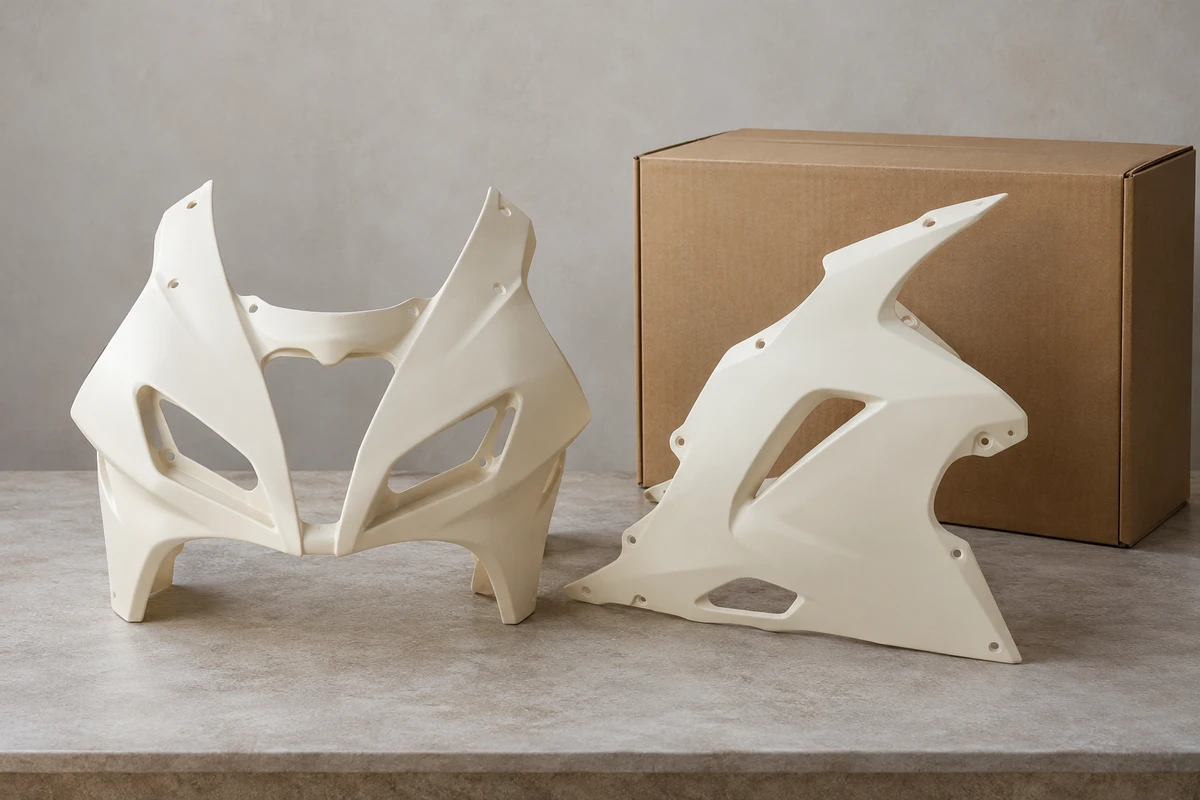
An unfinished motorcycle fairing delivered to a home or workshop can still be several professional handovers away from the buyer's intended result. Before comparing its delivered price with finished supply, identify the work, receiving locations and local movements that remain.
Start with the actual accepted panel or kit and a responsible technical provider. A low shipping subtotal cannot establish that an unknown panel can be fitted, finished or used. This article organizes commercial scope; it does not provide a bodywork completion method.
Establish the supplied state before naming the destination
AirTech's general policies describe its parts as unfinished, unpainted and undrilled, with mounting-tab provision varying. The same page contains order and return conditions, including an international-return exclusion. These named-supplier observations were checked on 14 October 2026. They are not universal aftermarket terms or a decision about enforceability. AirTech general policies
For the actual purchase, request an attributable supplied-state description: exact panel references, declared finish state, included fittings and explicit exclusions. Do not infer completed preparation from a glossy catalogue image or assume a broad complete kit label includes all professional work.
Where policy wording is unclear or conflicts with an offer, obtain order-specific written clarification and appropriate advice if rights are disputed. Do not use another supplier's policy to explain away a mismatch in this order.
Ask the completion provider to accept the actual proposal
Give the intended professional the panel information and approved application requirements before directing the delivery there. Ask what it can assess, which work it is willing to quote and what remains conditional on seeing the goods. A general refinishing price may not cover a panel whose application or supplied features are unresolved.
Keep technical acceptance and appearance approval separate. The provider may need to resolve application questions before any irreversible finish work is authorized. Purchasing should request that decision sequence, not prescribe holes, adhesives or preparation steps.
If several businesses are involved, identify the output each receives and hands over. One might assess the proposed application while another supplies an agreed finish. The actual responsible providers must determine the appropriate sequence; the buyer should not reverse it simply because a paint appointment is available sooner.
Quote the local movements between those stages
Name each physical handover and its agreed receiving point. First delivery to the buyer, transfer to an assessing workshop, movement to a finishing provider and final collection are possible events to check, not a claim that every fairing requires four trips.
Ask whether the relevant service offers include collection or delivery. If a transport amount is bundled, identify where it is included so the same local trip is not added twice. If the owner proposes collecting, record the actual commitment and any known constraints instead of entering a fictitious courier charge.
A proposal to ship directly to a professional may eliminate an owner-to-workshop movement, but only if that recipient agrees to receive the exact goods and the commercial arrangement is clear. Do not reroute an order to a workshop on the assumption that it provides storage or receiving services.
Keep a pre-work decision point
Before authorizing changes to the panel, reconcile the delivered identity and declared supply state with the actual order. Preserve any discrepancy and the seller's response. Ask how the contemplated work interacts with the proposed remedy rather than assuming a modified panel will be accepted back.
This does not establish a return right, deadline or blanket rule against all work. It keeps a specific buying decision visible while the owner can still decide on the known condition and terms. Appropriate providers and advisers must resolve technical or legal questions.
Fictional example: home delivery excludes the completion journey
A fictional buyer compares unfinished panel set F-5 delivered home with a separately scoped finished offer. The unfinished price omits the local professional's assessment, authorized finish work and final handover. The buyer has entered zero for those rows because no quotes exist.
The buyer asks the intended providers for their actual scope and receiving requirements. If they cannot accept F-5, the low-price option does not yet deliver the required outcome. If suitable proposals are obtained, the buyer adds only real, nonduplicated services and movements and keeps conditional work separate.
The resulting choice may favor either route. Its value is that no unassigned completion task is hidden behind the word delivered, and no purchasing approval is mistaken for fit or finish validation.
Buyer worksheet
| Record | What to establish |
|---|---|
| Actual supply | Exact panels, declared unfinished state and exclusions |
| Professional acceptance | Provider response for the approved application and proposal |
| Completion stages | Each agreed output, owner and unresolved technical question |
| Local movements | Real receiving points and included or separately quoted transport |
| Pre-work decision | Receipt discrepancy and remedy implications clarified before changes |
| Common endpoint | Same required professional handover for both buying options |
This is an original purchasing worksheet. It does not authorize physical work, establish legal treatment or replace a provider's assessment.
Bring the unresolved decision to the right provider
See Motorcycle parts for product context. A Motoparts sourcing request can identify the exact item and unanswered supplier question. Motoparts provides independent aftermarket and unbranded buying coordination and supplier negotiation. The named businesses above are documentary examples, not affiliations, branded-product offers or a promise that Motoparts supplies their services.
The initial form accepts a supported marketplace HTTPS link, an 8–1200-character description, or screenshots: up to five PNG, JPEG, WebP or GIF images, no more than 10 MiB each and 20 MiB combined. Other files need a separately agreed authorized exchange; the form is not a PDF, CAD or ZIP portal.
Frequently asked questions
Does delivered fairing mean ready to fit?
No. Use the actual supplied-state record and the responsible professional’s assessment. Unfinished supply can leave substantial work outside the product and freight offer.
Can I send the panels directly to a local professional?
Only after the recipient agrees to receive the exact goods under a defined scope. Confirm the address, custody and included services; do not assume free receiving or storage.
Should finishing begin before a delivered-scope discrepancy is resolved?
Keep the discrepancy and proposed remedy visible before authorizing irreversible changes. Obtain the appropriate provider decisions and clarify relevant terms; this article supplies no universal return rule or work sequence.
Does the AirTech policy govern every aftermarket fairing?
No. It is a bounded documentary example of unfinished supply and stated terms. Obtain the actual seller’s current order-specific conditions and appropriate advice for disputed rights.
Sources
Discuss a sourcing request related to this article.Unfinished Motorcycle Fairings: Budget the Work After Delivery