
Handlebar Clamp Kits: Show Complete and Partial Dispatches
Keep complete mounting variants separate from partial clamp-kit supply when an order is split across dispatches. Carton counts cannot show kit completion.
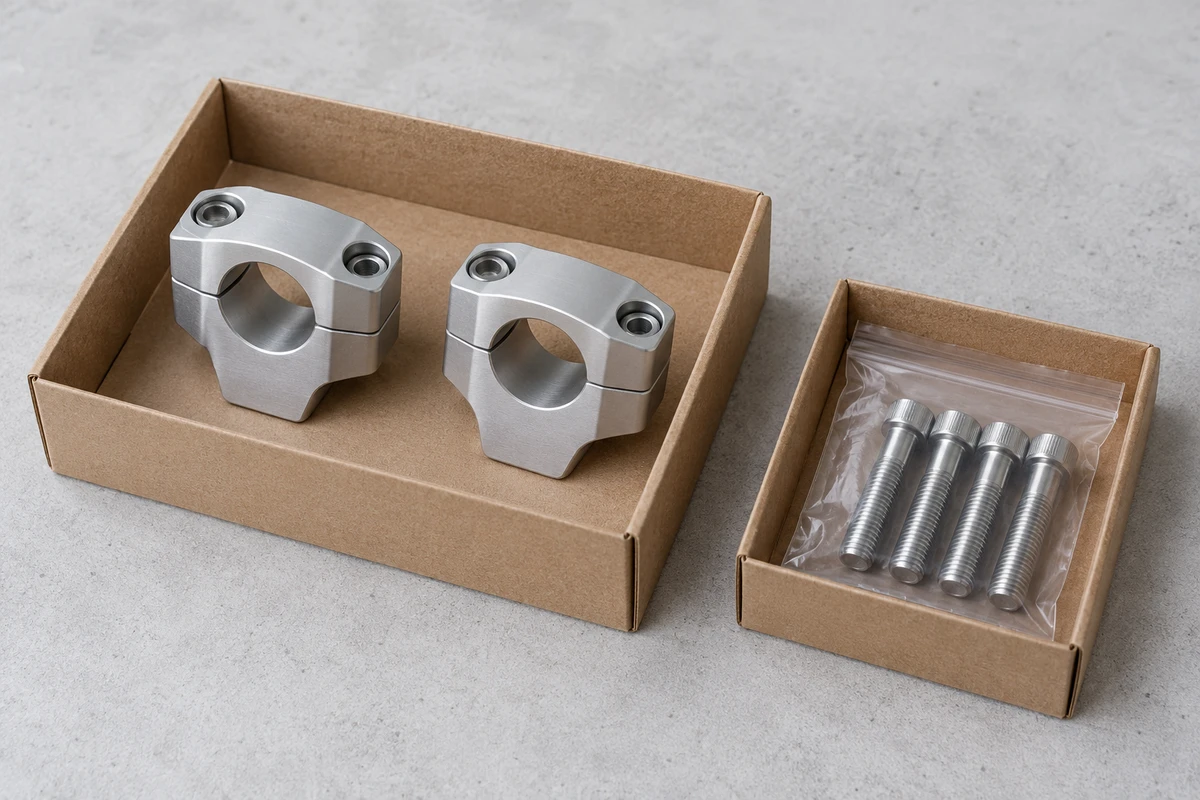
A split dispatch can leave an order with every mounting-kit code represented but no clear statement of which kits are complete. Before authorizing the split, ask the provider to show complete supplied units and incomplete portions separately for each approved handlebar-clamp variant. Do not call a partial portion one delivered kit simply because it occupies a labeled carton.
This is a commercial completeness review after product approval. It does not select handlebar diameter, mix clamp halves or prescribe a mounting method. The actual provider must define the contents of the accepted mounting-kit unit.
Keep the approved mounting variants distinct
Barkbusters' handlebar-clamp page lists separate codes for straight, tapered and triple-clamp mounting products. These are named-range distinctions checked on 14 October 2026. They do not establish common hardware, interchangeable halves or a detailed contents schedule for another offer. Barkbusters handlebar-clamp kits
Copy each accepted kit code and its provider-defined unit into the dispatch review. A broad line saying clamp kits can hide different completion states. Use the approved contents record to determine what the provider means by one complete unit; do not infer the count from catalogue photography.
If a provider proposes sending individual portions instead of complete units, ask it to identify that change explicitly. The buyer should not need to deduce partial supply from a packing-list total or a later explanation that more hardware will follow.
Compare the timing choices at the kit level
One proposal may send complete units of variant A now and hold variant B pending completion. Another may send partial portions of both variants now. Those proposals create different recipient states even if their first-dispatch piece totals match.
Ask for the actual complete-unit count in each dispatch group, the incomplete portions separately identified, and the provider's record of what remains due. This is not a demand-planning calculation or a promise about availability dates. Any stated date should keep its actual meaning, such as planned dispatch, rather than being converted into a guaranteed usable-delivery date.
Avoid using a missing portion from another variant to balance the list. The order's approved product identities remain fixed unless a separate substitution decision is authorized. A provider's claim that two items look the same does not grant the packing team that authority.
Fictional example: both variants present, neither complete
Imagine fictional order V-30 includes complete kits of variants A and B. A split proposal sends identified portions of A and B in the first release, with their remaining contents deferred. The packing list calls that release 'two kits.' No real hardware schedule or dates are represented.
The buyer asks the provider to replace the misleading unit statement with the actual complete and partial status. If neither approved unit is complete in the first release, the record should say so. Presence of both variant codes is not completion of either kit.
A revised proposal might send a complete A unit while keeping B together until its remaining contents are available. That could be commercially different for the buyer. It remains an actual option to obtain and review, not a promise that the supplier has enough A contents or can meet a date.
If the buyer accepts partial supply, preserve the outstanding portion under the original kit and order line. Authorization to dispatch part of B should not cancel the remainder or convert the purchase into a smaller kit without a separate agreed change.
Use a complete-versus-partial dispatch record
This is an original purchasing worksheet, not a technical standard or an instruction to handle the product.
| Review field | Record or request |
|---|---|
| Approved kit code | Exact accepted mounting variant and unit definition |
| Mounting variant | Distinct provider identity retained through the split |
| Dispatch group | Actual complete units and partial portions in each release |
| Provider completeness record | Contents basis supporting each completion statement |
| Backordered portion | Remaining supply linked to its original kit |
| Recipient status | Complete, partial or pending with exact buyer authorization |
Keep physical package count in the shipping record without using it as the commercial kit count. Several packages may contain one complete unit, or one package may hold partial portions of several units. The provider's contents and completion declaration must explain the actual case.
When the later portion dispatches, reconcile it with the retained outstanding record. A second tracking reference alone does not establish that the remaining contents are supplied; ask the provider to identify which outstanding portion it covers. Do not close other variants because one kit becomes complete.
Give the recipient a bounded status
The handover should identify which approved mounting kits are complete, which portions are arriving and what remains due. Keep the buyer's acceptance of the split attached to that precise scope. No recipient should have to discover a partial kit after reading an unqualified complete-kit label.
This record closes a dispatch-description question. It does not approve the physical packing, confirm mounting suitability or certify that any received component is ready for installation. Those responsibilities remain with the applicable providers.
Bring the exact change into the sourcing request
See Motorcycle parts for product context. A Motoparts sourcing request should identify the accepted product, the proposed packing change and the unanswered decision above. Motoparts provides independent aftermarket and unbranded buying coordination and supplier negotiation. Named manufacturers are documentary examples, not branded-supply offers, affiliations or evidence of another provider's capability.
The initial form supports a supported-marketplace HTTPS link, an 8–1200-character description or screenshots. It accepts up to five PNG, JPEG, WebP or GIF images, at most 10 MiB each and 20 MiB combined. PDF, CAD and ZIP files require a separately agreed authorized exchange. The form is not a technical-file portal; a request does not establish engineering approval or a specialist packing service.
Frequently asked questions
Can a partial clamp-kit carton count as one complete kit?
Not unless it contains the full provider-defined purchased unit. Keep physical package count separate from commercial kit count, and identify partial portions and outstanding contents explicitly.
Can missing items be borrowed from another mounting variant?
That would require a separate supported product decision. Preserve the approved variant identities and ask the responsible provider to resolve shortages. Visual similarity or a shared family name does not authorize interchangeability.
Does accepting a partial dispatch cancel the remainder?
Do not infer that change. Record the buyer’s actual authorization and keep the outstanding portion linked to the original kit and order line. Any reduction of the purchase requires its own accepted scope.
What closes the later outstanding portion?
Obtain a provider record identifying which remaining contents the later dispatch supplies and reconcile it to the retained partial-kit entry. A new tracking number or the presence of the variant code alone does not establish completion.
Sources
Discuss a sourcing request related to this article.Handlebar Clamp Kits: Show Complete and Partial Dispatches