
Spark Plug Multipacks: Preserve Each Original Box Identity
Keep individual spark-plug boxes associated with their contents beneath a new multipack sleeve. A bundle label cannot replace the original identifiers.
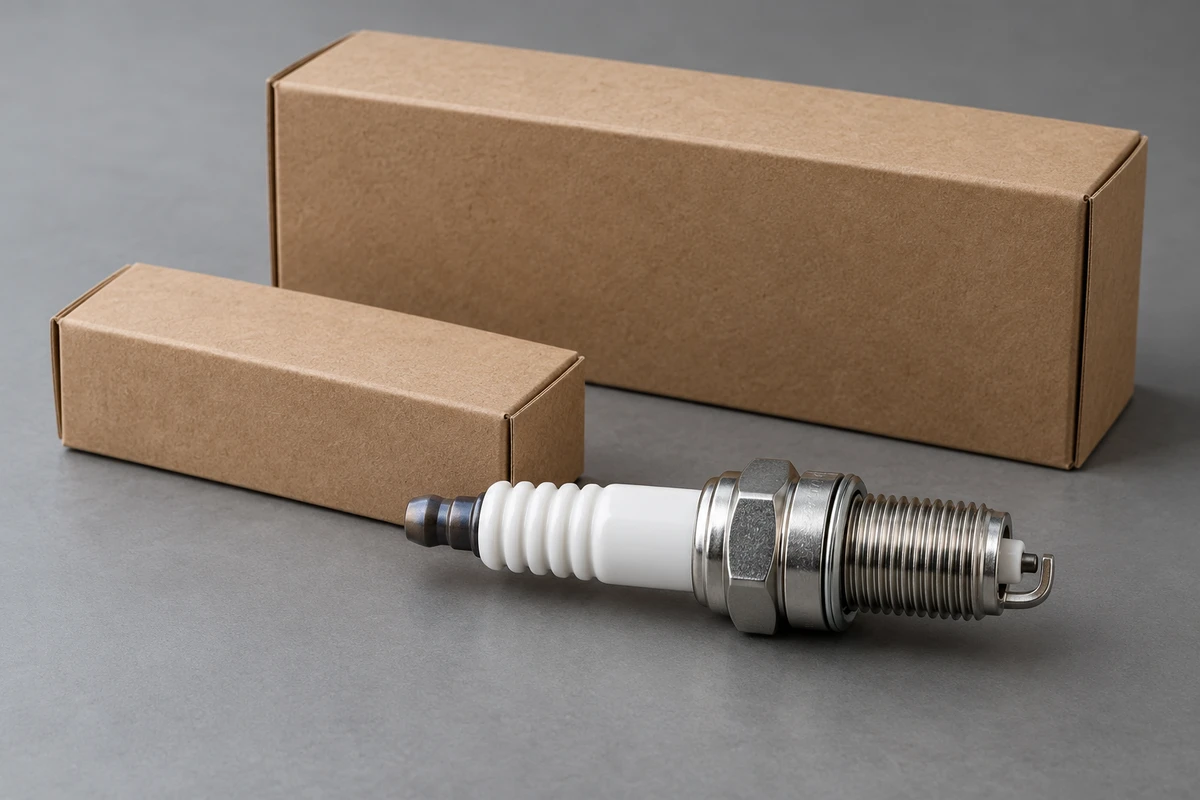
A new multipack sleeve can make several spark-plug boxes look like one retail unit. Before approving it, verify that the planned grouping preserves the association between each supplied plug and its own box. A clear bundle code is useful, but it should not erase the individual code-bearing packages beneath it.
This review assumes the actual plug references are already approved. It concerns packaging identity through grouping, not heat-range selection, cross-brand equivalence or authentication. Preserved identifiers can support later enquiries without proving a plug's origin or suitability.
Know which identifiers the box carries
Niterra North America's NGK explanation distinguishes the plug number marked on the plug from the plug and stock numbers printed on the box. It explains that the stock number supports inventory and is not a heat-range or type code. These are bounded observations within that maker's system, checked on 14 October 2026. NGK part and stock-number explanation
For the actual goods, retain the provider's complete supplied identifiers and their locations. Do not assume another brand uses the same system. Where the source distinguishes two number roles, keep both roles rather than copying whichever field is shortest onto the sleeve.
A sleeve reference identifies the bundle. It does not become a replacement manufacturer identifier for each plug. If the provider proposes discarding original boxes, that is a separate change to the evidence and supplied arrangement, not merely a new color scheme.
Review the final grouped state
Ask which original boxes sit beneath the sleeve and how each remains attributable to its plug. If existing records are used to document the grouping, identify the actual supplied boxes they cover. A generic catalogue image does not establish the contents of this multipack.
Check whether the sleeve hides the identifier fields needed at the agreed handover. The response may identify a provider-supported viewing or record arrangement; do not prescribe openings, cuts or copying of manufacturer codes. Any copied administrative information should be clearly linked to its source rather than presented as newly issued maker data.
For a uniform multipack, confirm that the provider declares every included unit against the agreed complete reference. A bundle containing mixed codes is a different commercial scope unless it was explicitly ordered as an assortment. Do not normalize a discrepancy by changing the sleeve to a broader family name after packing.
Fictional example: a correct sleeve over one different box
Imagine fictional multipack M-6 intended to contain repeated units of approved reference P-A in their supplied individual boxes. The sleeve names P-A, but the provider's grouping record shows one box as P-B. These are invented codes, unrelated to a real NGK product.
The buyer asks the provider to resolve the specific box before approving the grouped presentation. The sleeve's correct text cannot settle the difference underneath. Nor should the packing team remove the P-B box and place its unknown contents into a P-A box to make the record look consistent.
Suppose the supplier says P-B is only its internal shorthand. Request the exact mapping to the supplied product and box identifiers. That may clarify the administrative label, but it should not overwrite the original observation. If the product itself differs, keep it as a product-scope exception for the responsible owner.
Keep the unit-to-box relationship in the worksheet
This is an original purchasing worksheet, not a technical standard or an instruction to handle the product.
| Review field | Record or request |
|---|---|
| Plug identity | Complete accepted and supplied product references |
| Original box identifiers | Existing codes and their distinct roles |
| Sleeve reference | Administrative bundle identity and artwork issue |
| Mixed code check | Uniform scope or explicitly ordered assortment |
| Accessible record | Agreed way to recover original associations |
| Unresolved mismatch | Specific box, missing information and provider response |
Distinguish unavailable information from a mismatch. An obscured code is not necessarily a different code; it is a visibility or record gap. A clearly different designation needs reconciliation of the actual supplied item. Keep those statuses separate so the provider receives the right question.
A provider declaration that the original associations were preserved is useful provenance, not independent authentication. If an origin concern emerges, retain the relevant unit, packaging and purchase records for the appropriate separate review. Do not imply that matching numbers alone close it.
Freeze the bundle without losing its children
The final approved sleeve issue should point to the exact included unit references and preserved original-box arrangement. A later change in pack quantity, code mix or box replacement should reopen the affected record, even if the outside dimensions remain unchanged.
The buyer's result is a multipack whose individual identities remain recoverable at the intended handover. It does not certify the plugs, select an engine application or guarantee that every code will remain visible under every handling condition. Those broader claims require evidence beyond a sleeve review.
Bring the exact change into the sourcing request
See Motorcycle parts for product context. A Motoparts sourcing request should identify the accepted product, the proposed packing change and the unanswered decision above. Motoparts provides independent aftermarket and unbranded buying coordination and supplier negotiation. Named manufacturers are documentary examples, not branded-supply offers, affiliations or evidence of another provider's capability.
The initial form supports a supported-marketplace HTTPS link, an 8–1200-character description or screenshots. It accepts up to five PNG, JPEG, WebP or GIF images, at most 10 MiB each and 20 MiB combined. PDF, CAD and ZIP files require a separately agreed authorized exchange. The form is not a technical-file portal; a request does not establish engineering approval or a specialist packing service.
Frequently asked questions
Can the multipack sleeve replace the individual spark-plug boxes?
That is a separate supply and identification change requiring the actual provider’s supported proposal. A bundle code does not retain every original box identifier or its association with the contained plug by itself.
Does an NGK stock number identify heat range?
The cited NGK explanation says its stock number is an inventory identifier, not a heat-range or plug-type code. Keep its role distinct from the plug number and do not generalize that numbering system to other brands.
What if one box under the sleeve has another code?
Record the exact difference and ask the provider to reconcile that unit with the accepted multipack scope. Do not broaden the sleeve description, exchange boxes or infer equivalence merely to make the labels agree.
Do matching box and plug codes prove authenticity?
No. Preserving their association supports traceability but does not authenticate origin or confirm condition and application. Any origin concern needs its own appropriately scoped maker or supplier review.
Sources
Discuss a sourcing request related to this article.Spark Plug Multipacks: Preserve Each Original Box Identity