
Sprocket Packaging: Review Holder Contact by Variant
Check whether one proposed holder contacts different features on plain and rubber-cushioned sprocket variants before extending a packaging approval.
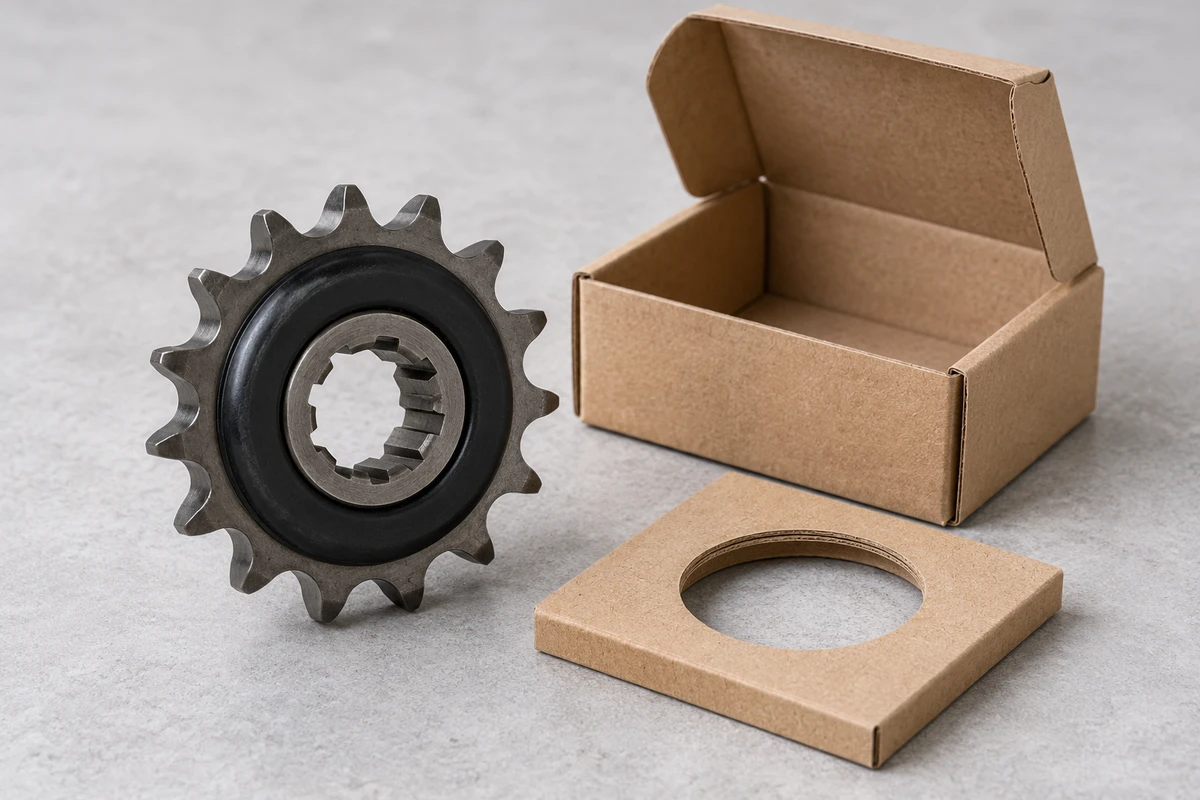
A holder developed around a plain sprocket should not automatically be assigned to a rubber-cushioned variant with a similar base designation. Before extending the pack approval, ask the provider to show which features the holder contacts on each exact variant. A common outer envelope does not establish a common contact arrangement.
The sprocket references and application should already be approved. This article concerns a packaging-holder proposal, not tooth selection, chain conversion, material performance or a recommendation to change variants.
Preserve the full variant in the packing record
JT Sprockets' JTF513 catalogue entry separately names JTF513RB as a rubber-cushioned alternative. That is a specific catalogue distinction, checked on 14 October 2026. The entry does not provide an approved packaging holder or permission to clamp a cushioning feature. JT JTF513 catalogue
Use the actual accepted provider references, including meaningful suffixes, in the layout register. If the order contains both plain and cushioned variants, give each a contact row rather than using one shortened family name for the entire group.
The catalogue distinction is a prompt to obtain exact product information, not a way to infer geometry from a name. Ask the responsible owner for the approved view or record needed to locate the relevant features. Do not estimate dimensions, gaps or contact forces from a photograph.
Compare the holder's contact path
Ask the packaging provider to identify every region that its proposed holder touches, retains or supports on each variant. It should also identify any neighboring product that could contact the cushioning feature under the reviewed layout. A statement that the part fits in the holder addresses space, not permitted contact.
Keep the holder's identity and revision visible. If the same holder is proposed for both variants, request evidence or a provider decision covering both actual interfaces. A review of the plain variant should not silently become a review of the rubber-cushioned one.
Do not infer that a cushioning feature is a suitable packing support because it is called rubber. Its product role does not establish permitted packaging loads or contact. The product and packaging owners must resolve those questions for the exact arrangement.
Fictional example: same tray, different contact
Suppose fictional variants SP-P and SP-R are already approved for separate order lines. A holder proposal H-5 shows its contact on an identified region of SP-P. The provider then lists SP-R under the same approval without supplying a corresponding view. These codes are invented and do not describe a JT packing design.
The buyer asks for the missing SP-R contact map. It is premature to approve the extension or declare the holder damaging. The unanswered point is which feature the holder would actually meet and what supports that use.
Suppose the new view shows contact on SP-R's cushioning feature where SP-P presented another surface. The reviewer now has a different interface to assess. The buyer requests a product-specific disposition or a revised proposal instead of prescribing another clamping location.
If the revised layout changes a neighboring sprocket's position as well, include that relationship in the review. A holder-only drawing may leave a second product-to-feature contact unanswered. The final approval should cover the whole represented contact arrangement, not merely the feature most visible in the first image.
Use a variant-specific holder sheet
This is an original purchasing worksheet, not a technical standard or an instruction to handle the product.
| Review field | Record or request |
|---|---|
| Approved sprocket variant | Full accepted reference including suffix |
| Plain/cushioned distinction | Exact product evidence and represented features |
| Proposed holder contact | Named regions for each variant and holder issue |
| Neighboring part | Other contents that may meet the relevant feature |
| Provider evidence | Applicable constraints, assessment and remaining limits |
| Layout scope | Exact combination covered by the decision |
Separate known no-contact requirements from interfaces that simply lack review. If the product owner has prohibited a contact, the proposal must address that stated constraint. If the contact is unknown, request a decision rather than inventing a prohibition or treating the blank field as permission.
A suitable source record might identify product features and constraints, while a separate packaging response addresses the proposed holder. Retain their different roles. Neither a catalogue suffix nor a drawing alone establishes transport protection or an undamaged arrival.
Limit approval to the represented combination
Record the accepted product variant, holder issue, contact regions and any neighboring contents alongside the provider's actual conclusion. A later variant or holder substitution should return for an applicability check, even if nominal carton size stays the same.
The buyer's result is a controlled answer about extending a holder proposal to a different feature arrangement. It makes no noise-reduction, durability or fit claim and supplies no holder fabrication, tightening or sprocket-installation instructions. Those boundaries keep packaging review focused on the actual change.
Bring the exact change into the sourcing request
See Motorcycle parts for product context. A Motoparts sourcing request should identify the accepted product, the proposed packing change and the unanswered decision above. Motoparts provides independent aftermarket and unbranded buying coordination and supplier negotiation. Named manufacturers are documentary examples, not branded-supply offers, affiliations or evidence of another provider's capability.
The initial form supports a supported-marketplace HTTPS link, an 8–1200-character description or screenshots. It accepts up to five PNG, JPEG, WebP or GIF images, at most 10 MiB each and 20 MiB combined. PDF, CAD and ZIP files require a separately agreed authorized exchange. The form is not a technical-file portal; a request does not establish engineering approval or a specialist packing service.
Frequently asked questions
Can plain and rubber-cushioned sprockets use the same holder?
That requires a provider-supported review of the actual contacts on both variants. A similar base code or outer envelope does not establish a common interface. This article neither approves nor universally rejects a shared holder.
Does rubber cushioning make a feature suitable for packing support?
No permitted support condition follows from the material description alone. Ask the product and packaging owners to identify the relevant limits and assess the exact proposed contact. Do not invent force or clearance values.
What does the JTF513 example establish?
The catalogue separately identifies a rubber-cushioned alternative to the named base family. It does not establish the buyer’s actual geometry, application or packaging design, and it is not a recommendation to change sprocket variants.
When should the holder decision be reviewed again?
Return changes in product variant, holder revision, contact location or neighboring contents to the responsible owner. Preserve the previous decision as evidence for its original combination rather than automatically extending it.
Sources
Discuss a sourcing request related to this article.Sprocket Packaging: Review Holder Contact by Variant