
Sealed Chain Receipt: Record Ring and Stiffness Concerns
Keep missing-ring, residue and reported stiffness observations separate when asking a supplier to assess an already specified sealed chain.
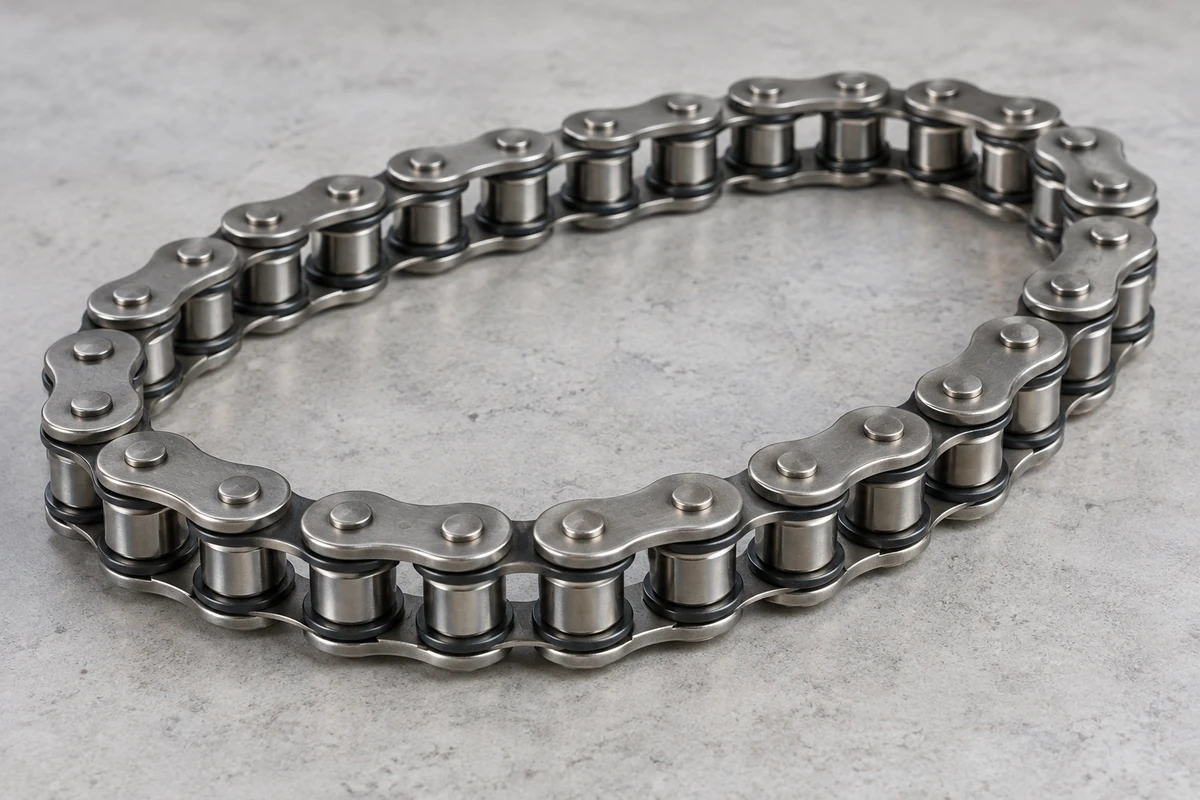
A sealed chain can arrive with grease on its surface and still have an unresolved ring-condition question. Record the exact unit, the visible location and what was observed before accepting an explanation about lubrication. The receiving decision is whether the supplier has answered the delivered-condition concern for that chain.
This starts after the ordered model has been established. It does not choose a connecting link, diagnose wear or provide a cleaning procedure. A receiving record cannot establish whether the chain is ready for installation or use.
Separate the ring observation from the grease description
D.I.D’s FAQ identifies rust, stiffness and missing X-rings as condition concerns in its chain-replacement guidance. That is maintenance guidance for the maker’s products, not a new-shipment acceptance standard or a universal rule for every sealed chain. It supports preserving those observations separately rather than treating fresh lubricant as a complete response. D.I.D chain-condition FAQ
Describe the evidence at its actual strength. An existing photograph may show no visible ring at an identified location; that does not necessarily establish that the ring is absent rather than obscured. Keep the whole-unit view associated with the detail, and distinguish a clear observation from an area that cannot be seen within the agreed receiving scope.
Use the order reference and supplier’s delivered designation to anchor the record. If either is missing, ask for identity clarification alongside the condition question. Do not substitute a generic picture of another chain or assume that all units in the same carton share the observed condition.
Retain how stiffness was reported
A statement that a chain felt stiff needs an origin: who reported it, when, and during what already completed activity. Record that account without asking the receiver to reproduce it. “Reported during unpacking” and “demonstrated in a supplier video before dispatch” describe different evidence, even when both reports use the same word.
Do not flex the chain repeatedly, force an affected link, remove a ring or add a chemical to make the observation clearer. Such action would change the received condition and introduce a separate intervention. If a technical assessment needs more than the existing observations, its scope and method belong with the responsible competent provider.
Keep residue appearance descriptive too. A glossy film, a localized dry-looking patch and a supplier’s statement about factory grease are separate entries. Appearance alone does not identify the substance, establish its compatibility or prove that the internal lubrication is satisfactory.
Ask about treatment before arrival
Request the supplier’s actual declaration about cleaning, relubrication or other treatment of the affected unit before dispatch. Ask what record links that declaration to this chain. If the supplier does not know, retain “prior treatment not established”; do not replace it with “factory condition” because the sales listing says new.
This history does not require a receiving employee to investigate physically. Existing packing images, order messages and the supplier’s production or dispatch records may answer the administrative question. Where no traceable history exists, the uncertainty itself belongs in the assessment request.
A later treatment proposal should remain separate from the arrival report. The buyer should not silently authorize cleaning or lubrication as the remedy for an unexplained ring or stiffness concern. Obtain an answer addressing the specific condition and the proposed disposition before revising the commercial record.
Buyer worksheet
Use one record per identified unit or clearly defined affected group. This is an original purchasing aid, not a test procedure or acceptance standard.
| Field | Record to preserve | Question that remains open |
|---|---|---|
| Chain unit | Order line, full delivered model and unit evidence | Whether the observed chain is the ordered item |
| Ring location | Whole-unit reference plus existing detail location | Absent ring versus obscured or unconfirmed view |
| Arrival residue | Descriptive appearance and supplier declaration | Substance identity and treatment history |
| Reported stiffness | Reporter, time and existing observation circumstances | Exact condition assessment without a new force test |
| Prior treatment | Supplier record of any pre-dispatch intervention | Undocumented cleaning or relubrication |
| Disposition owner | Actual assessment reference and affected-unit scope | Who can resolve the condition and commercial next step |
Fictional example: fresh lubricant leaves the ring question open
Imagine a fictional new chain, C-01, whose existing arrival images show a location at which a ring is not visible. The receiver has also recorded an earlier report of localized stiffness. The seller offers additional lubricant and describes the surface grease as normal. These details are invented and do not describe a real shipment.
The buyer’s response should identify two unanswered questions: does the maker or responsible supplier confirm the ring condition at that location, and what is the assessment of the reported stiffness? A general grease explanation answers neither. It may clarify the expected surface appearance, but that clarification should have its own limited status.
If the seller proposes a replacement, request the replacement’s exact identity and document its arrival independently. The replacement proposal is a commercial next step, not proof that the first chain was defective or that the replacement has passed technical review. If the seller instead proposes treatment, leave that proposal pending the appropriate authorization and product-specific assessment.
Close the question at the right level
Useful closure language identifies the unit, the concern, the evidence reviewed and the decision owner. “Supplier explained the visible grease; ring concern remains open” is more informative than “chain checked.” Preserve any restrictions in the actual assessment and avoid turning one resolved location into a batch-wide release.
This receipt record should help the buyer obtain a precise answer. It should not grow into a chain-wear guide or a justification for trying the product on a motorcycle to settle the dispute.
Keep the request tied to the received item
Use the Motorcycle parts category for product context and the Motoparts sourcing request for the exact received reference and unresolved supplier question. Motoparts provides independent aftermarket and unbranded buying coordination and supplier negotiation. The manufacturer example above is documentary evidence, not a branded-goods offer, affiliation, inspection-service promise or engineering approval.
The sourcing form supports a supported-marketplace HTTPS link, an 8–1200-character description, or one or more screenshots. Image limits are five PNG, JPEG, WebP or GIF files, 10 MiB per file and 20 MiB combined. It does not accept PDF, CAD or ZIP uploads. Arrange other technical files only through a separately agreed, authorized exchange.
Frequently asked questions
Does fresh grease resolve a missing-ring concern?
No. A grease explanation concerns the described surface treatment. It must not close a separate ring observation unless the applicable product assessment actually addresses that location. Keep any uncertainty about visibility explicit.
Should I move the chain to demonstrate stiffness?
Do not create a new manipulation or force test for this worksheet. Preserve the existing report, who made it and the circumstances. Any further assessment requires an agreed competent method for the exact product.
Can D.I.D maintenance guidance decide whether a new shipment passes?
It provides a bounded manufacturer example of condition concerns. It does not supply the acceptance criteria for another supplier or a new-delivery inspection. Use the actual purchase agreement and applicable product assessment.
What if the seller replaces the affected chain?
Record the replacement identity and its relationship to the original claim, then document the replacement receipt separately. A promised or completed replacement does not by itself establish technical suitability or clear other units.
Sources
Discuss a sourcing request related to this article.Sealed Chain Receipt: Record Ring and Stiffness Concerns