
Clutch Steel Plate Receipt: Separate Size and Heat Concerns
Keep documented plate-thickness discrepancies and heat-mark observations on separate receipt records against the approved plate schedule.
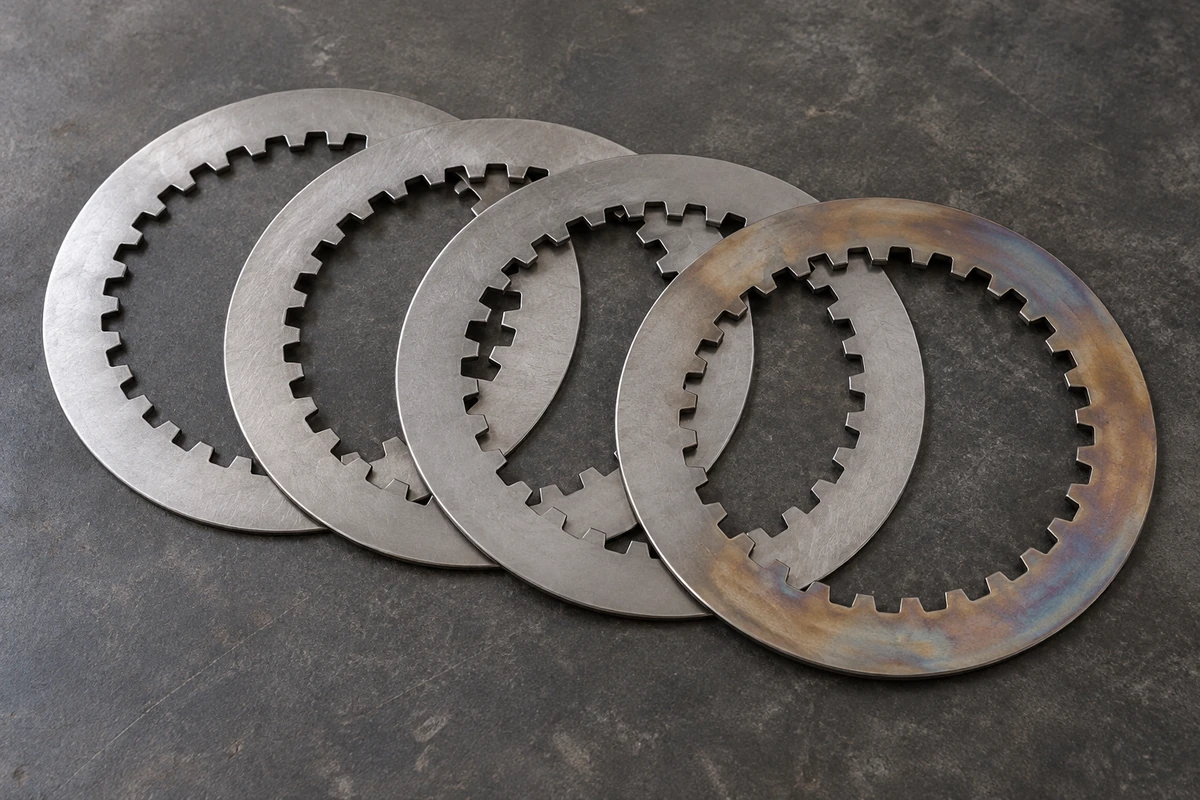
A complete clutch-plate count does not resolve either a documented thickness mismatch or a heat-mark concern. Match the delivered steel plates to the approved schedule, preserve the source of any measurements already made, and ask the supplier to answer each discrepancy separately.
The rebuild scope is assumed to be established. This guide does not choose a clutch stack, set thickness or flatness limits, or determine whether a used plate can be retained.
Keep plate identity connected to the approved schedule
Use the accepted plate-group reference and any position distinctions required by the authorized schedule. Give each affected piece an administrative identity linked to existing packaging or images. Do not physically mark a working surface to create that identity.
If several visually similar plates were removed from their labeled packs, record any uncertainty in their association. A total count may establish how many pieces were received while leaving which piece matches which requirement unresolved. Do not fill those gaps by arranging plates according to appearance.
Retain the schedule’s controlling revision. If the seller supplies a different sequence or reference after delivery, record it as a changed document and ask whether it applies to the actual order. Purchasing should not redesign the stack to accommodate what arrived.
Separate the manufacturer’s two condition points
Barnett’s metal-drive-plate guidance notes that similar-looking plates can differ in thickness and separately addresses heat discoloration or hot spots. These are different concerns. The page does not supply a universal thickness or flatness value for a new delivery, and this article does not adopt its reuse or installation advice. Barnett metal-drive-plate guidance
The purchasing implication is to avoid using one observation to answer another. A documented dimensional match would not explain an independent heat-mark concern. A clean-looking surface would not establish that a plate meets the approved dimensional requirement.
Preserve measurement provenance without creating a test procedure
Where an authorized competent inspection has already produced a dimensional report, record the exact plate identity, reported result, units, method reference and reviewer. Keep the applicable order criterion beside it. A number without a method or an association to the affected piece may not support the comparison the buyer needs.
This worksheet does not instruct receiving staff how to measure a plate or define an acceptable deviation. If the criterion or method is missing, ask the responsible technical owner to resolve it. Do not borrow a value from another clutch or make an informal ruler image into a precision result.
Keep nominal order data and actual reported measurements in separate fields. If a supplier simply repeats the catalogue thickness, label it as declared specification rather than a measurement of the delivered plate.
Buyer worksheet
Use one record per identified unit or clearly defined affected group. This is an original purchasing aid, not a test procedure or acceptance standard.
| Field | Record to preserve | Question that remains open |
|---|---|---|
| Plate unit | Affected-piece identity linked to packaging and existing views | Similar plates mixed without traceability |
| Approved schedule | Exact set or position requirement and controlling revision | Count substituted for the authorized plate relationship |
| Measured record owner | Competent report, units, method reference and reviewer | Catalogue nominal value presented as actual measurement |
| Thickness discrepancy | Reported result against its actual agreed criterion | Missing method or tolerance filled by guesswork |
| Heat-mark observation | Existing surface description and any attributed diagnosis | Discoloration alone used to invent thermal history |
| Separate dispositions | One response per piece and per dimensional/condition issue | Complete-kit reply or one replacement clearing everything |
Record surface concerns without diagnosing heat history
Use the existing observation’s wording and location. “Discolored patch in the supplied image” does not by itself establish a heating event, its cause or its extent. If a competent report identifies heat-related damage, preserve that attribution rather than presenting the receiving coordinator as the diagnostician.
Do not polish, grind, flatten, heat or install the plate to test a seller’s explanation. Such work would change the condition and may also change the very dimension being disputed. Any further assessment needs an appropriate qualified method and authorization.
Ask the supplier to address the surface concern independently of the thickness record. A statement that all plates belong to a complete kit is a contents claim, not an answer about the identified piece’s dimension or condition.
Fictional example: two discrepancies need two answers
Imagine fictional delivery K-18 with an approved steel-plate schedule. Plate A has a documented thickness discrepancy reported by the authorized inspector. Plate B has a separate discolored-area observation awaiting assessment. The seller replies that the box contains the correct total number of plates. No real measurements or product conditions are represented here.
The buyer records the count response and keeps two open entries. A requires reconciliation of the reported measurement, criterion and plate identity. B requires a response to the surface observation. Neither is resolved by the count, and an answer for A should not be copied to B.
If the supplier proposes replacing A only, record that scope and leave B’s condition status visible. If it proposes a whole replacement set, obtain the exact set reference and preserve the authorized stack requirement rather than assuming every complete set is suitable.
Close at the piece and issue level
The final record should identify the result for each affected plate and each concern. A corrected measurement record may resolve a documentation error without addressing a surface observation. An agreed replacement can settle a commercial action without proving the condition of other retained pieces.
Avoid one blanket “kit passed” status unless the actual competent review and agreement support its full scope. A precise receiving record helps the buyer see which item needs a response while preserving the established rebuild specification.
Keep the request tied to the received item
Use the Dirt bike parts category for product context and the Motoparts sourcing request for the exact received reference and unresolved supplier question. Motoparts provides independent aftermarket and unbranded buying coordination and supplier negotiation. The manufacturer example above is documentary evidence, not a branded-goods offer, affiliation, inspection-service promise or engineering approval.
The sourcing form supports a supported-marketplace HTTPS link, an 8–1200-character description, or one or more screenshots. Image limits are five PNG, JPEG, WebP or GIF files, 10 MiB per file and 20 MiB combined. It does not accept PDF, CAD or ZIP uploads. Arrange other technical files only through a separately agreed, authorized exchange.
Frequently asked questions
Does the correct number of steel plates establish the correct set?
No. Reconcile the delivered identities with the approved schedule and any applicable competent inspection record. Count alone does not answer a dimensional discrepancy or a separate condition concern.
Can plates that look alike have different thicknesses?
Barnett’s guidance identifies that possibility. Preserve the exact schedule and properly attributed measurement evidence; do not infer thickness or suitability from appearance or borrow a universal value from this article.
Does discoloration automatically prove overheating?
A visible patch is an observation to assess. Keep any technical diagnosis attributed to its actual competent source, and ask for a response to the affected location without inventing a heat history.
Can I polish or flatten a suspect plate before reporting it?
No such intervention is authorized here. Preserve the received state and existing evidence. Altering the surface or shape could change both the condition and the dimensional question being reconciled.
Sources
Discuss a sourcing request related to this article.Clutch Steel Plate Receipt: Separate Size and Heat Concerns