
Carburetor Rebuild RFQ: Preserve Market and Calibration Scope
Identify the actual carburetor and market-specific calibration source before accepting a rebuild kit described for another market.
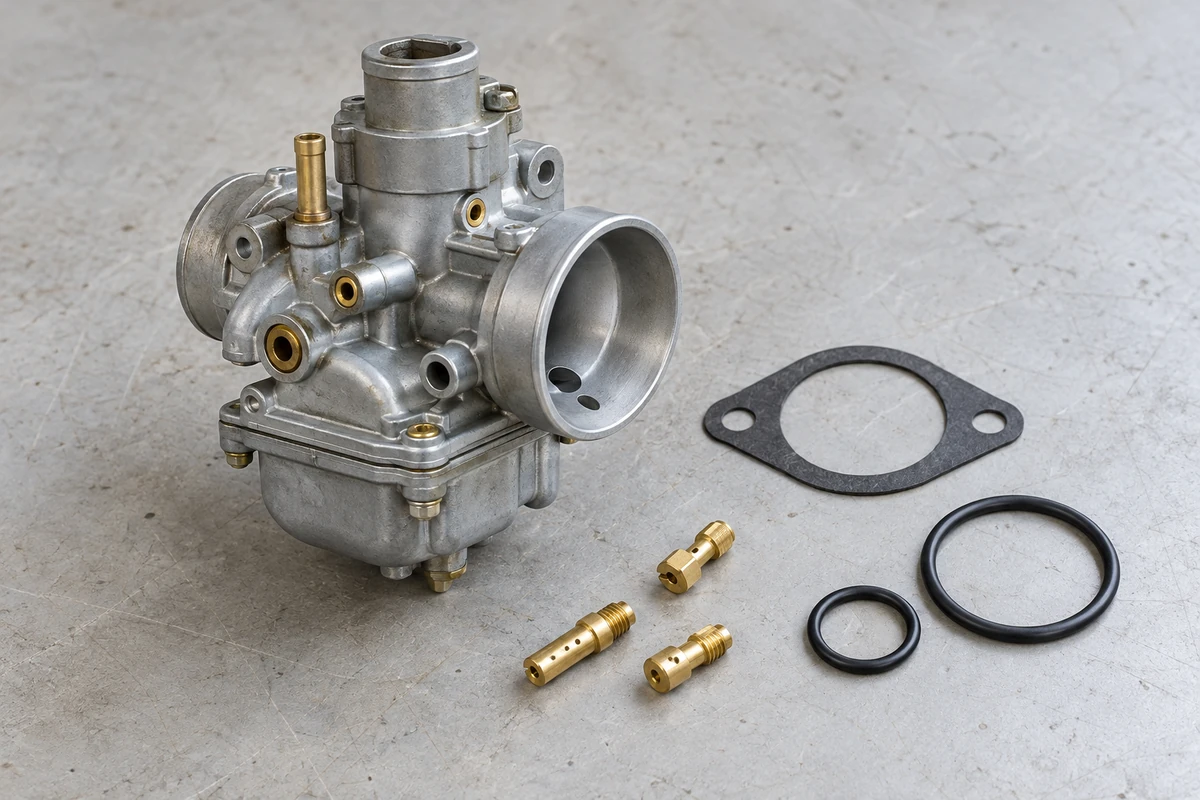
An RFQ for a carburetor rebuild kit should identify the carburetor itself and the applicable market specification. A kit that carries the same vehicle name may still leave the calibration basis unanswered. Keep that question separate from whether the package has enough pieces for one or two carburetors.
The aim is to preserve the authorized rebuild requirement. This guide does not choose jet sizes, diagnose running problems, tune fuel delivery or approve changes to emissions-related equipment.
Retain the manufacturer's market qualification
All Balls' carburetor-rebuild range says its kits use US-model jet sizes and flags non-US applications for caution. The same page notes a two-carburetor contents scope for relevant ATV models. These are separate claims: market/calibration basis and supplied quantity. Neither proves a particular kit is suitable for an imported machine. All Balls carburetor rebuild range
For purchasing, retain the market caveat in the quote record. Do not shorten a listing to the vehicle model and discard the qualification. Where the seller calls a kit 'OEM size,' ask which market and reference that statement means.
Avoid treating the machine's current country of use as evidence of its original specification. An imported vehicle may require records from its original market, and a replaced carburetor may require a different assembly record altogether. Ask the appropriate technical provider to resolve the applicable configuration.
Make calibration provenance visible
Record the actual carburetor identity and the approved calibration source, including any known authorized changes. Keep a list of the exact offered jet references beside that requirement. If a supplier provides only a broad jet-size claim, ask for the component-level list and the source it relies on.
Purchasing should not infer calibration from the appearance of an old jet or reconcile conflicting numbers by choosing a midpoint. Missing or inconsistent references go back to the technical owner. The RFQ can make that problem visible without prescribing a replacement size.
For a kit serving multiple carburetors, preserve any position-specific references required by the approved record. A statement that the box serves two carburetors answers quantity only. Do not assume that every included calibration item is interchangeable between positions or variants.
A fictional imported ATV enquiry
Suppose a fictional workshop requests a rebuild kit for an imported ATV with a documented non-US calibration requirement. Offer A quotes a US-based kit and says the vehicle name matches. Offer B confirms contents for two carburetors but leaves the offered jet-reference list blank.
A needs evidence addressing the actual market and carburetor configuration. Its model-name match does not remove the supplier's market qualification. B needs the component-reference record before the buyer can see whether it answers the approved calibration requirement. Counting two sets cannot close that gap.
If the provider finds a supported same-calibration candidate, preserve the exact kit and its source in the revised request. If an alternative changes calibration, classify it separately rather than including it in an ordinary price comparison. The original enquiry has not authorized a tuning or emissions change.
Ask for affordability without erasing the market boundary
Request actual prices for candidates that answer the same documented requirement. Keep supplier explanations of exclusions and differences attached to their product references. A cheaper generic kit may require more evidence, and that uncertainty must remain visible instead of becoming an assumed saving.
An independent sourcing request can seek an aftermarket alternative or a drawing-based proposal within supported scope. It cannot certify calibration, regulatory acceptance or the outcome of a rebuild. Have the exact application and component differences reviewed by the responsible provider before purchase; do not use this worksheet as installation or jet-selection guidance.
A product-specific quotation worksheet
| Field | Record and request | Keep unresolved |
|---|---|---|
| Carburetor identity | Actual installed assembly and reference | Vehicle model alone |
| Vehicle market | Applicable original/configured market evidence | Current country assumed to define calibration |
| Calibration source | Authorized reference and known approved changes | OEM wording without a market |
| Offered jet references | Exact list and source for the quoted kit | Unlabeled sizes or a generic assortment |
| One or two carburetors | Explicit contents and required position distinctions | Correct count treated as calibration match |
| Deviations | Unresolved market/component differences and provider | Changed calibration hidden as economy replacement |
Use this original purchasing worksheet to record the supplier’s actual answers. It is not a test procedure or fit certificate; unresolved safety-sensitive application questions require exact product evidence and confirmation by the responsible provider.
Prepare a sourcing request
Use the ATV parts category for the product group and the Motoparts sourcing request for the exact item and unanswered question. Keep any affordable aftermarket or unbranded alternative tied to the authorized application or released drawing. Motoparts is an independent buying agent for aftermarket and unbranded parts; a request does not establish supplier manufacturing capability, guaranteed savings, branded affiliation or technical approval.
The initial form accepts a description of 8–1200 characters and up to five PNG, JPEG, WebP or GIF images, limited to 10 MiB each and 20 MiB total. Authorized drawing images may start a customization enquiry. CAD, PDF and ZIP files require a separately agreed authorized exchange; the image field is not a technical-file portal.
Frequently asked questions
Does a US-model kit automatically suit the same model sold elsewhere?
No. Preserve the exact carburetor and applicable market-calibration record, then request evidence for the offered kit. The manufacturer’s market qualification must remain visible.
Does a two-carburetor kit prove both calibrations are correct?
No. It describes a contents scope. Ask for the exact offered component references and any position-specific distinctions required by the authorized application.
What does OEM jet size mean in a quotation?
Ask which vehicle, carburetor, market and source the supplier means. The phrase is incomplete without that provenance and is not evidence that an imported or modified machine shares the same requirement.
Can the RFQ specify a different jet to make a cheap kit usable?
A changed calibration requires separate technical authorization. Keep this enquiry focused on the approved rebuild requirement; do not choose jet sizes or modify emissions functions through purchasing shorthand.
Sources
Discuss a sourcing request related to this article.Carburetor Rebuild RFQ: Preserve Market and Calibration Scope