Motorcycle and scooter parts / Buying guide
139QMB vs 157QMJ: How to Check Parts Fitment
Last updated
Published by 1688 Moto Parts · Review method
Key takeaways
- Photograph the complete designation, including maker information and prefixes/suffixes.
- Treat code families as search clues and verify the actual part through the correct manual or catalog.
- Check CVT, electrical and chassis compatibility separately; no universal code decoder resolves every part.
Use 139QMB or 157QMJ to narrow the engine family. Confirm the installed assembly and the offered reference before treating a replacement part as a match.
An engine code narrows the search. It does not uniquely identify every internal part, transmission, electrical system or chassis connection. Use the complete marking alongside the manufacturer’s parts information and the component you are replacing.
Codes such as 139QMB, 152QMI and 157QMJ are useful marketplace search terms. Their presence is not permission to order every listing that repeats those characters.
Turn this guide into a buying request
Keep this page as context. Add what you know; review everything before sending. No purchase is made at this step.
Continue to request →-
Photograph the entire stamped designation, including prefixes, suffixes and adjacent manufacturer information. Take a second wider photo showing where it sits on the engine.
-
Distinguish the model designation from an individual serial number, a casting number and a part number. Each may be useful, but they identify different things.
-
Record the vehicle maker, model, model/build year, market and known replacement engines or modifications.
-
Use the manual to locate the marking. Clean gently with a suitable method; do not grind, abrade or alter an identification stamp.
Identify the engine and the assembly for each quote line
Illustrative workshop request: one scooter is marked 139QMB, another 157QMJ. The workshop needs a transmission item on one and a charging-system component on the other. Record two quote lines with separate photos, engine stamps and assembly references. Ask the seller to name the applicable variant for each line. A label of “GY6” alone leaves both applications pending.
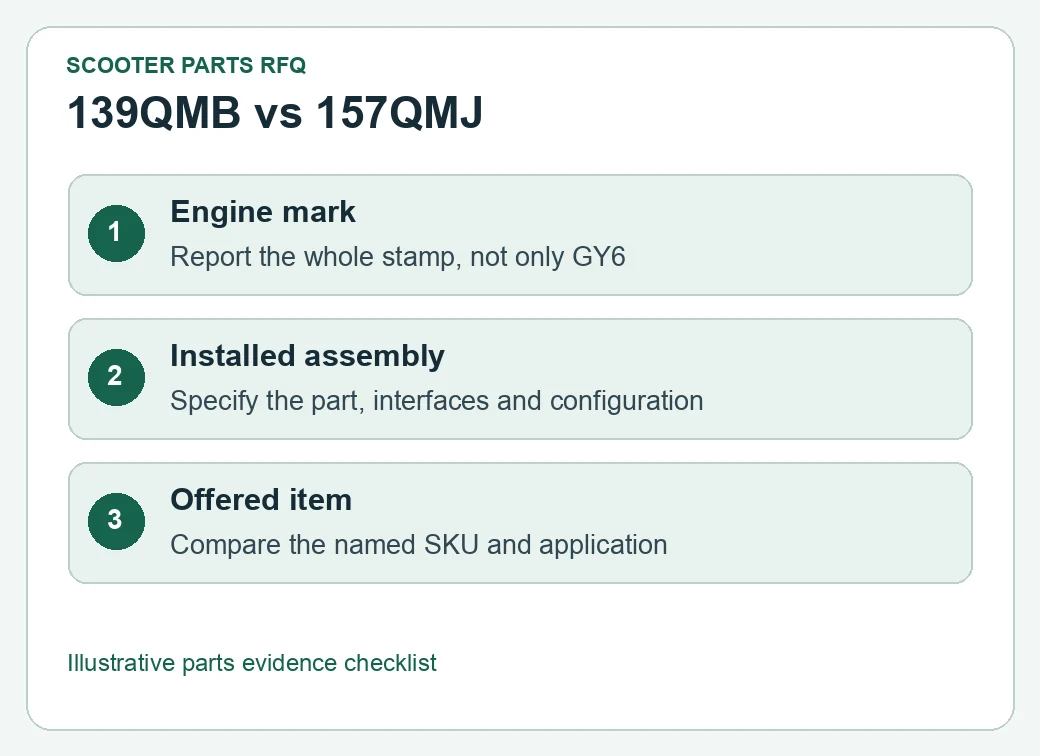
- Engine stamp
- Supply the entire engine marking, vehicle model and any changed assembly.
- Assembly identity
- Identify the exact transmission, carburetor or electrical system for the part.
- Quoted reference
- Record the seller’s exact SKU and compare its documented application.
Scooterworks lists QMB139 and 157QMJ among different scooter engine families. Those examples help with identification; use the vehicle and part documentation for your exact combination.
An engine marking narrows the search. If your next line is a 139QMB belt, compare the 669 and 729 examples against the installed case before requesting a sample.
In this guide
Record the marking, not a remembered shorthand
- Photograph the entire stamped designation, including prefixes, suffixes and adjacent manufacturer information. Take a second wider photo showing where it sits on the engine.
- Distinguish the model designation from an individual serial number, a casting number and a part number. Each may be useful, but they identify different things.
- Record the vehicle maker, model, model/build year, market and known replacement engines or modifications.
- Use the manual to locate the marking. Clean gently with a suitable method; do not grind, abrade or alter an identification stamp.
What the familiar code families actually help with
Parts sellers often group 139QMB-related products under small scooter engines, 152QMI/157QMJ under larger scooter families, and other designations under vertical or horizontal singles. Treat those as candidate-search categories until the maker’s documentation confirms the exact designation.
Numeric fields in common designation schemes can indicate nominal cylinder/bore information, and letters distinguish other features. This guide does not supply a universal character decoder: manufacturer variants and suffixes matter, and a nominal bore does not specify stroke, piston geometry or every related part. Verify the code against the correct manual.
The evidence the code leaves unresolved
- Cylinder/head work: actual revision, bore/stroke application, piston pin and height, valve arrangement, stud spacing and passages.
- CVT work: case/drive layout, specified belt reference, shaft and pulley interfaces, roller size/mass and clutch assembly.
- Electrical work: ignition power source, wiring/pin functions, pickup/controller requirements and charging-system specification.
- Engine replacement: mounts, output alignment, cooling, fuel/control systems, clearance and destination eligibility.
- Chassis parts: frame/model application, wheel/brake/suspension interfaces and load requirements. These cannot be inferred from an engine stamp.
A real catalog counterexample to engine-code-only ordering
Gates’ Boost catalogue, edition 2020, page 25 maps Baotian BT 125 T-2 (GY6 152 QMI), through 2006, to BOOST 9802-21705. On the same page, BT 125 T-7 A1 with engine 152QMI maps to 9802-21704. Page 59 likewise gives different belt references for ZNEN 125CC BN 152QMI 4T and ZN125T-7C Euro 3 with engine 152QMI.
We checked the original PDF rows on 2 October 2026. This is historical application evidence that the family code alone is insufficient. It is not a current fitment approval: page 86 says to consult Gates when the catalogue is over two years old. Use the exact model and current manufacturer confirmation before ordering; these belt mappings say nothing about CDI, cylinder or chassis interchangeability.
Gates Boost catalogue: printed pages 25 and 59, with age warning on page 86 ↗
Use the manufacturer’s identification record as a second key
KYMCO’s official Agility 50/125 manual asks for VIN and engine serial number to assist parts ordering. Its Agility 125 specification lists DC-CDI. The manual was prepared in February 2009, document T300-KG10SA/KN25SA-US-A5; the 2026 upload path does not make it a 2026 model manual.
For a scooter matching that manual, a seller’s generic “AC GY6 CDI” claim would leave a system mismatch to resolve before purchase. This does not establish a connector pinout or prove any particular replacement module fits. Obtain the applicable wiring/service information and exact replacement reference; do not transfer that ignition specification to every Agility or GY6 variant.
KYMCO Agility 50/125 manual: Agility 125 specifications and VIN/ESN record ↗
Convert a seller’s broad compatibility claim into a decision
Hypothetical workshop request: “152QMI belt, 12 pieces” is incomplete. Replace it with exact scooter model, market/build details, full stamp photo, current catalog reference, old belt marking, case/drive evidence, quantity and a list of modifications. If the supplier confirms only the family code, leave the line on hold.
When the supplier offers a different reference, require its current application source and an explanation of the difference. Do not average dimensions from two listings, decode an OE-reference string into assumed belt dimensions, or order both on the theory that one should fit. The rejected alternative and reason are valuable repeat-order records.
An illustrative mismatch check
Assume two scooters are both advertised as “157QMJ.” One seller offers a CVT belt based only on that label; another asks for the vehicle application, existing belt reference and drive-layout details. Neither seller’s response alone proves the match, but the second gives you a route to verify it.
Record the catalog-recommended reference, compare the offered belt’s identification and specified dimensions, and resolve any different length convention or case variant before ordering. No scooter or belt was tested for this example; it illustrates the questions, not a real fitment result.
If the code is missing or unclear
Ask the vehicle or engine manufacturer, an established parts distributor or a qualified workshop to identify it from available records and physical evidence. Include photos of the complete engine, intake/exhaust arrangement, covers and existing part markings.
Do not dismantle an engine solely to guess its family or assume a few external measurements settle all internal parts. For an unresolved safety-critical application, stop the purchase until the identification and specification are reliable.
Create a reusable workshop fitment card
Keep one card per confirmed variant: machine identifiers, code photo, catalog source/date, part reference, relevant measurements, sample/fit-check outcome and the limits of that check. Save rejected candidates and the exact reason for rejection.
Send that record with the quantity and destination in a sourcing request. Future orders still need change control: a different maker, suffix, catalog revision or modified machine can require a fresh check.
Download the variant and shipment screening card
The worksheet keeps full identification separate from catalog references, measured condition, approval and shipping classification. It also contains a hypothetical electrical-mismatch exercise. Recheck a card after an engine swap, changed supplier revision or a newly discovered modification.
Download: motorcycle fitment, electrical questions and shipping-screening worksheet ↗
Questions & answers
Common questions
- Does 139QMB guarantee one belt or case length?
- No. Use the specific scooter/engine application and transmission evidence. The family code is insufficient.
- Can I identify a CDI by plug shape?
- No. Confirm the power source, pin functions, pickup and required ignition characteristics against the wiring and service information.
- Should I ignore the vehicle brand?
- No. The brand/model may lead to the correct manual and application catalog. Combine it with the actual engine marking and modification history.
Your next step
Have a link you want checked?
Send a 1688 or Taobao product link and you get back the specification in English, the supplier check, and the landed cost to your country before you commit to anything.
Get a quote