motorcycle, scooter and small-displacement parts / Buying guide
Scooter CVT parts explained
Last updated
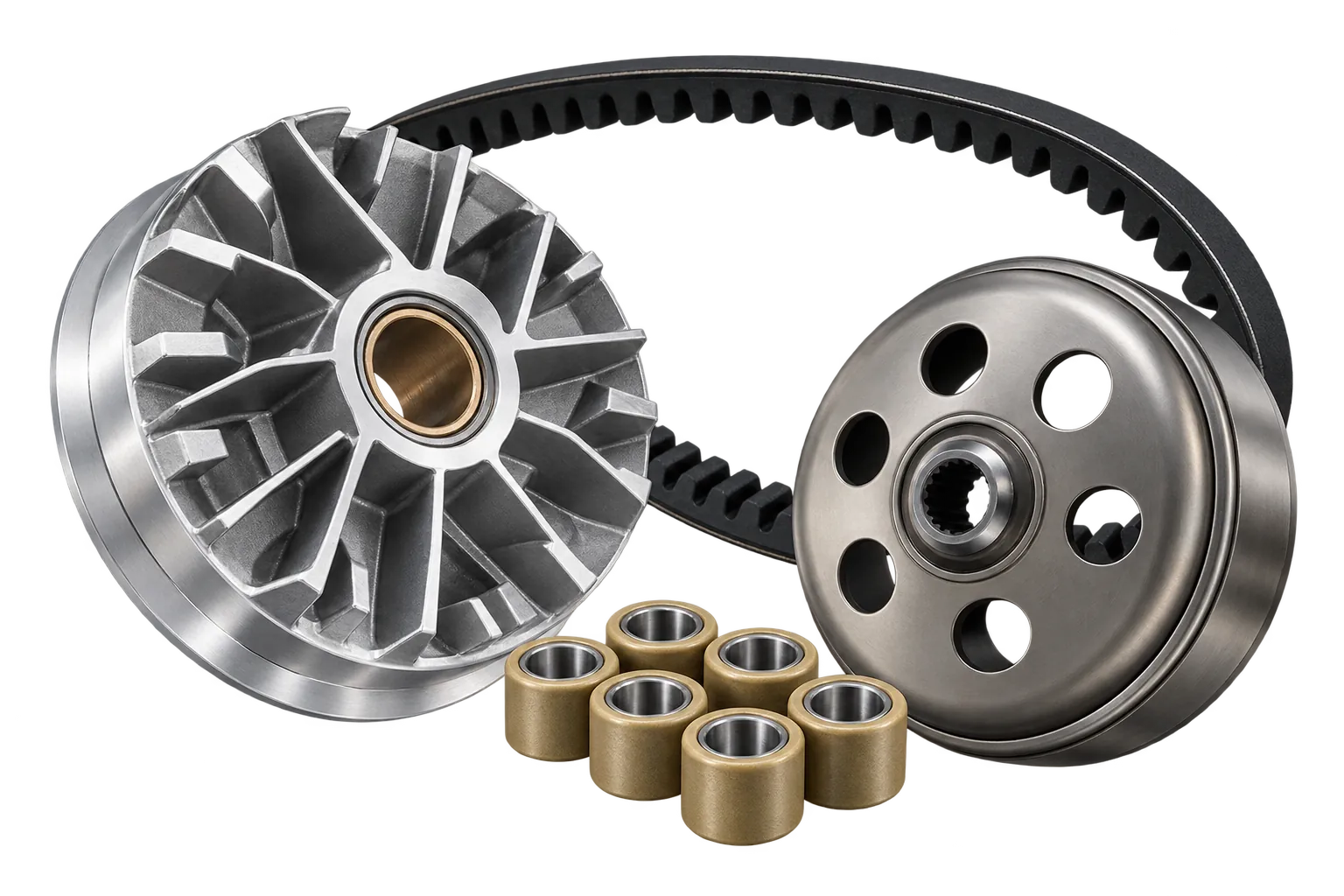
A scooter has no gears. A belt runs between two variable-diameter pulleys, and the whole character of the machine — how it pulls away, where it stops accelerating — comes from five components that cost very little and are made in volume in China.
They are also the parts where ordering the wrong variant is easiest, because "GY6" on a listing covers several incompatible transmissions.
In this guide
What each part does
- Variator — the front pulley. Its ramp profile and roller weights decide how quickly it changes ratio.
- Rollers — weights inside the variator. Heavier shifts earlier for top speed, lighter shifts later for acceleration.
- Belt — transmits the drive. Length, width and angle are fixed by the transmission and are not adjustable.
- Clutch — engages the rear pulley. Spring rate decides engagement speed.
- Torque spring — the rear spring. Stiffer holds a lower ratio longer, improving hill climbing at the cost of top speed.
The measurements to take before ordering
- Belt: length × width × angle, usually printed on the belt itself. This identifies the transmission family unambiguously.
- Variator: outer diameter and the roller bore and width.
- Roller: diameter × width, and the weight in grams.
- Clutch: outer bell diameter.
- Engine code from the crankcase, which narrows everything else.
What changing them actually achieves
Roller weight is the one adjustment with a large effect and near-zero cost. A few grams lighter transforms low-speed response on a loaded scooter; a few grams heavier raises cruising speed on a flat commute. It is worth buying two or three weights and trying them.
Everything else is a smaller effect for more money, and a variator claiming a large power gain on a stock engine is claiming something the engine cannot supply.
Questions & answers
Common questions
- How do I know my belt size?
- It is printed on the belt. If it is worn off, measure the outer circumference and width and we can match it.
- Will a 150cc variator fit my 125cc?
- Sometimes — both are long-case, but roller bore and ramp profile differ. Measure rather than assume from displacement.
- How often do these wear out?
- Belts and rollers are consumables, commonly every 5,000–10,000 km. Buying a season's worth in one shipment is where the saving is.
Your next step
Have a link you want checked?
Send a 1688 or Taobao product link and you get back the specification in English, the supplier check, and the landed cost to your country before you commit to anything.
Get a quote